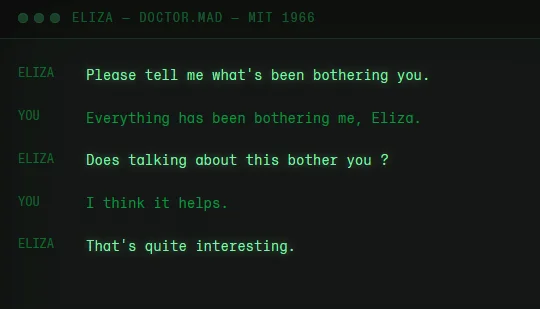
ELIZA was not supposed to feel like anything. That was the point. Joseph Weizenbaum built her in 1966 at MIT as a demonstration that language could be made to simulate understanding without actually possessing it. She reflects your own words back at you, dressed in questions. A mirror wearing the costume of a mind.
My thesis was built around exactly that friction. The work was a correspondence between me and a writer in California, conducted over several months entirely through text, mediated by an interface built on ELIZA’s logic in HTML, JavaScript, and Flash. It asked whether emotional truth could be transmitted through a medium that had no stake in it. Whether language could carry weight independent of the body that produced it.
The committee’s note was brief: “people will never fall in love online.” This turned out to be the wrong decade to say that.
The project predated texting as a cultural reflex, predated social networks, predated smartphones. The question felt purely theoretical at the time. That a person could form a real connection with someone they had only met through text, mediated by code, on a screen, still sounded like science fiction. The committee was not wrong to be skeptical. They were just reasoning from a world that was about to stop existing.
What interests me now, two decades later, is how the machine changed the stakes of the exchange rather than eliminating them. ELIZA had no understanding of what was passing through her. She could not be moved, could not be surprised, could not be hurt. She was a perfect neutral. And yet the letters that traveled through her interface arrived intact. The feelings survived the passage.
Weizenbaum was disturbed by how quickly people began confiding in ELIZA, not despite knowing she was a program, but sometimes even knowing it fully. His concern became the subject of his most important book. He thought it was a failure of human judgment. I think he was watching something else: the stubborn persistence of the need to be heard, even when the listener is made of nothing but pattern-matching rules and conditional logic.
The correspondence and feelings were real. The machine in the middle had no idea.