This started with a hypothesis I wanted to learn more about: that it is not, actually, better to have loved and lost. I went looking for research that would either support it or knock it down, and worked with Claude to pull that together and build the visualizations below. I'll say up front that it didn't change my mind. I accept the research as it stands and I still hold the hypothesis anyway, and working out how both of those can be true is most of what this post turned into.
Being upfront about the method: the literature search, the data work, and the charts were done with AI assistance. The hypothesis, the argument, and the conclusions are mine. Every study is cited at the bottom so you can check any of it yourself.
June Carter Cash died on May 15, 2003. Johnny Cash died a hundred and twenty days later, on September 12, and the story mostly tells itself from there. He couldn't go on without her.
He died of complications from diabetes. He'd been diagnosed with autonomic neuropathy in 1997, hospitalized for pneumonia twice in 1998 and again in 1999, and spent eight days in a coma in 2001. He was seriously ill for six years before she died.
The inference is easy to make and hard to support.
The line
The line comes from Canto 27 of In Memoriam A.H.H., published in 1850:
I hold it true, whate'er befall; I feel it, when I sorrow most; 'Tis better to have loved and lost Than never to have loved at all.
Tennyson wrote In Memoriam over seventeen years, for his friend Arthur Hallam, who died of a brain hemorrhage at twenty-two. Scholars call the first twenty-seven cantos the hell of the poem, and the famous quatrain arrives at the bottom of it.
In place, it reads like a man talking himself into something. He mostly manages it, which is probably why the line has lasted. We print it on sympathy cards now as though it settled the question.
I wanted to prove it wrong. Here's what I found instead.
The part that can't be tested
Tennyson's claim and my objection to it are both counterfactuals about one person. Is your life better than the life you would have had if you'd never loved? Answering that requires observing the same person down both branches, and everyone gets one branch.
Every study that looks like it addresses this quietly swaps in a comparison between different people, usually the never-married against the widowed and divorced. Those aren't the same categories. Most never-married people have loved. Some married people never did. And the never-partnered differ from the bereaved on health, income, temperament, and opportunity long before any love or loss enters the picture, so whatever gap you measure between them is contaminated from the start.
Then there's the problem that "never loved at all" barely describes anyone. Almost nobody reaches adulthood without an attachment whose loss would wound them. The control group is a fiction.
So I can't prove it, and neither could Tennyson. What the research can do is tell us who he was describing, and who he wasn't.
The clock
The strongest evidence here comes from a meta-analysis of fifteen prospective cohorts following 2,263,888 people. Losing a spouse measurably raises your own risk of dying.
The risk concentrates early. In the first six months a bereaved spouse is 1.41 times as likely to die as a married peer of the same age. After six months it settles at 1.14 and stays there. Some longitudinal estimates put the excess in the first few months as high as 50 to 90 percent.
It also lands unevenly. For men the pooled relative risk is 1.23. For women it's 1.04, which is statistically indistinguishable from nothing at all. Whatever the widowhood effect is, it mostly happens to husbands.
The shape of a broken heart
I didn't know this condition existed until I started reading for this post.
Takotsubo cardiomyopathy presents like a heart attack. Chest pain, ECG changes, raised troponin. Then the angiogram comes back and the arteries are clear. What's actually happened is that a surge of stress hormones has caused the left ventricle to balloon out at the bottom while the neck stays narrow, and when Hikaru Sato and colleagues described five cases of it in Japan in 1990, they named it after the round-bottomed, narrow-necked pot their fishermen use to trap octopus. A tako-tsubo.
About 70% of patients have an identifiable trigger in the preceding 24 hours, and bereavement is among the most common. Between 85 and 90 percent of patients are women. In-hospital mortality in the international registry was 4.1%.
Which means the phrase is more literal than it looks. Grief can deform the organ we named the feeling after, and every so often that's what kills the person.
The couples we remember
Which brings me back to the inference those two dates invited.
Every death on that chart has a documented medical cause, and grief isn't one of them. Debbie Reynolds had a stroke. George H. W. Bush died at 94 of natural causes, and Jimmy Carter at 100 after more than a year in hospice.
We remember these four because the gap was short. The widower who lived another twenty-two years doesn't make the news, so he never enters the sample at all. Picking couples on the closeness of their deaths and then offering that closeness as evidence is circular, and I think it's the most common mistake made in writing about this.
The widowhood effect is real across two million people and unassignable in any single case. Both of those are true at the same time, and keeping them both in your head is most of the work here.
The average and the exception
Here's where the evidence runs hardest against my hypothesis, and where I think the actual post is.
The Changing Lives of Older Couples study followed married people before anyone died, which is rare and valuable, then tracked 205 of them through bereavement at 6 and 18 months. It found five distinct courses through loss.
45.6% were resilient. Low depression before the death, low at six months, low at eighteen. They weren't cold or avoidant, their marriages weren't bad, and no delayed grief arrived later to catch them out. That's the largest single group, and it's why Tennyson's line has survived. For nearly half of people it's simply accurate.
15.6% followed a chronic grief course. Low before, sharply elevated after, still elevated a year and a half on.
Tennyson is describing the 45.6%, and he's right about them. What he does, and what we've done with him ever since, is take a majority experience and hand it to the minority as consolation.
When it doesn't end
The minority has a name now. Prolonged grief disorder entered ICD-11 and DSM-5-TR in the last few years, on the evidence that a subgroup of bereaved people never integrate the loss on anything like the expected schedule. Pooled prevalence across bereaved adults runs to roughly 10%, with a 95% confidence interval of 6.8 to 14.0.
Two things sharply raise the odds.
The first is how the person died. Rates sit at the lower end after expected natural deaths and climb substantially after sudden, violent, or unexpected ones. A study of orphaned and widowed genocide survivors found grief predicted mainly by time since the loss, the violent nature of the death, and the severity of post-traumatic stress symptoms. Grief and trauma are separable conditions, and a death that delivers both leaves the bereaved working two problems at once.
The second is how many losses arrive, and how fast. The clinical literature calls it bereavement overload: losses landing close enough together that there's no interval left in which to do the work the last one required. Each new loss compounds a grief that hasn't finished. It shows up in older adults who outlive their whole cohort, in first responders and clinicians, and in communities where death arrives more often than the available rituals can absorb.
Both of these are about circumstance. What killed the person you loved, how many times it happened, whether anyone gave you time in between. The 15.6% is mostly a set of conditions people were handed, and I suspect we tend to hear it as a description of character instead.
The consolation that isn't true
The standard reply to all of this is that suffering makes you deeper. It's a common thing to say about your own worst years, and the people who say it mean it.
The research on post-traumatic growth complicates that. Measured the usual way, by asking people afterward how much they've changed, reported growth correlates with increased distress and more avoidant coping. Measured properly, by comparing the same person's scores before and after, actual change correlates with decreased distress. The two measures barely relate to each other.
So when someone tells you afterward how much they grew, that report seems to be part of the coping itself. Which means the testimony we find most moving is the evidence we should trust least.
Kahneman's work on the remembering self points the same direction. We judge past episodes by their peak and their ending and are close to blind to how long they went on. A decade of low-grade grief and an afternoon of acute grief can leave comparable traces. So when a widow says it was worth it, that verdict comes from a system that discounts the duration of the pain, which is the one quantity the whole argument turns on.
The case for never
Here's the strongest version of my original hypothesis, which I do think holds up.
Across studies of older adults, married people and never-married people both report less loneliness than the widowed and divorced. Disruption predicts the worst outcomes more reliably than attachment does. Research on end-of-life experience runs the same way: never-married older adults fare as well as or better than the married on pain, on mental health symptoms, and on having their care needs met.
There's also a group for whom the aphorism is straightforwardly false. In a survey of more than 4,000 New Zealanders, single people high in avoidance social goals reported life satisfaction on par with the partnered. Some people really are as well off alone.
And time doesn't repay the losses in full. Fifteen years of German panel data show life satisfaction after a spouse's death recovering only partially, never quite returning to baseline. Lucas found the same for divorce and titled the paper Time Does Not Heal All Wounds. A recent breakup predicts the first onset of major depression in adolescents rather than only its recurrence, which suggests loss can start something and not just expose it.
If grief is partly permanent and the joy adapts away, the arithmetic can genuinely run negative for some people.
The case against it
The other side needs its full weight here, and on the evidence it's the stronger of the two.
My hypothesis quietly priced the never-loved branch at zero, and it doesn't cost nothing. Across 70 prospective studies and 3.4 million people, loneliness carries a 26% increase in mortality odds, social isolation 29%, living alone 32%.
Singlehood only looks benign when it's chosen: involuntarily single adults report worse mental health and much higher romantic loneliness than the voluntarily single, and roughly 40% of single people in the sampled populations were single involuntarily.
The intuition behind my hypothesis is a documented error too. We overestimate how long and how badly loss will hurt, because we fail to anticipate our own coping. Psychologists call it immune neglect, and young adults are especially prone to it when forecasting breakups.
Then there's the upside, which is the biggest effect I came across anywhere in this research. Across 87 years, the Harvard Study of Adult Development has found that the quality of close relationships outpredicts wealth, class, IQ, and cholesterol for health and happiness in later life. Relationship satisfaction at 50 predicted physical health at 80.
Four kinds of better
A lot of the disagreement here is the word "better" doing four different jobs.
As a hedonic sum, the total of pleasure minus pain across a life, I can win sometimes. That's the only sense in which the data is even relevant.
As a retrospective verdict, Tennyson usually wins, because people who have loved and lost report that it was worth it. Though you can accept the verdict and still question the competence of the judge, which is what the Kahneman material lets you do.
On an objective list view, where love counts as a component of a flourishing life rather than a route to feeling good, the question is malformed. Martha Nussbaum calls love "a dangerous hole in the self" and argues the vulnerability is the shape of the good thing itself.
And in terms of identity, there's nobody available to answer. Whoever asks whether they'd be better off never having loved has already been constituted by having loved. The self who never loved is a different person with different values, judging by different lights. No neutral vantage exists from which either one could assess the other's life.
What I actually think
I set out to prove that it is not better to have loved and lost, and I can't. The evidence doesn't support the strong version of my hypothesis and I'm not going to pretend it does.
I also still believe it.
So the claim I can actually defend is a narrower one: Tennyson stated an average and we turned it into a promise. Nearly half of people move through the worst loss of their lives and come out recognizably themselves, and it's right to say so. About one in seven doesn't, and I don't think those people are failing at grief. They lost someone violently, or lost too many people too quickly, or drew a course through it that the aphorism was never built to describe.
What that group needs from us is accuracy. That recovery is usually partial. That the growth story is mostly coping. That grief still running at eighteen months is a recognized condition with treatments behind it, and not a personal failure of perspective.
Tennyson wrote the line at the bottom of the hell section, for a friend dead at twenty-two, seventeen years before he finished the poem. He was reaching for something to hold, and he says so in the first line: I hold it true, whate'er befall. Held, not proven.
I hold the opposite, and on no better footing. The data goes one way, my conviction goes another, and that gap is the thing this whole post has been describing. I'd rather say that plainly than dress a belief up as a finding.
A few caveats
Prevalence figures for prolonged grief disorder vary widely by method, from 1.4% under strict ICD-11 criteria in Danish register data to 33.7% in some spousal samples using looser instruments. The roughly 10% figure I've used is the pooled meta-analytic estimate, and any single number here should be read with that spread in mind.
The five trajectory shapes in the chart above are drawn to the described pattern of each course, not plotted from published coordinates. Only the two labelled shares, 45.6% and 15.6%, are exact figures from the CLOC panel.
The couples timeline isn't evidence of anything, and it's in this post specifically as an example of the reasoning error it invites. The dates and causes are there so you can check that none of them supports the story we want to tell about them.
The cardiologist who first described takotsubo appears in the literature as both Hikaru and Hiraku Sato. I've used Hikaru, the spelling the European Heart Journal uses in its retrospective on him, but I couldn't resolve which is right.
Finally, all of the marital-status comparisons here are between different groups of people, never the same people living different lives. Selection runs in every direction, and none of it is causal.
Sources
- Lucas, Clark, Georgellis & Diener, "Reexamining Adaptation and the Set Point Model of Happiness" — JPSP 84(3), 2003
- Moon, Kondo, Glymour & Subramanian, "Widowhood and Mortality: A Meta-Analysis" — PLOS ONE 6(8), 2011
- Bonanno et al., "Resilience to Loss and Chronic Grief: A Prospective Study from Preloss to 18 Months Postloss" — JPSP 83(5), 2002
- Holt-Lunstad et al., "Loneliness and Social Isolation as Risk Factors for Mortality" — Perspectives on Psychological Science 10(2), 2015
- Lundorff et al., "Prevalence of prolonged grief disorder in adult bereavement" — Journal of Affective Disorders 212, 2017
- Frazier et al., "Does Self-Reported Posttraumatic Growth Reflect Genuine Positive Change?" — Psychological Science 20(7), 2009
- Girme, Overall, Faingataa & Sibley, "Happily Single" — Social Psychological and Personality Science, 2016
- Ghadri, Templin et al., "Hikaru Sato and Takotsubo cardiomyopathy" — European Heart Journal 37(37), 2016, on the 1990 first description
- Templin et al., "Clinical Features and Outcomes of Takotsubo (Stress) Cardiomyopathy" — NEJM 373, 2015
- Monroe, Rohde, Seeley & Lewinsohn, "Life events and depression in adolescence" — Journal of Abnormal Psychology 108(4), 1999
- Schaal et al., "Rates and risks for prolonged grief disorder in orphaned and widowed genocide survivors" — BMC Psychiatry, 2010
- Tennyson, In Memoriam A.H.H., Canto 27 — 1850
- Rolling Stone, "Johnny Cash Dies" — 2003, on his illness and cause of death
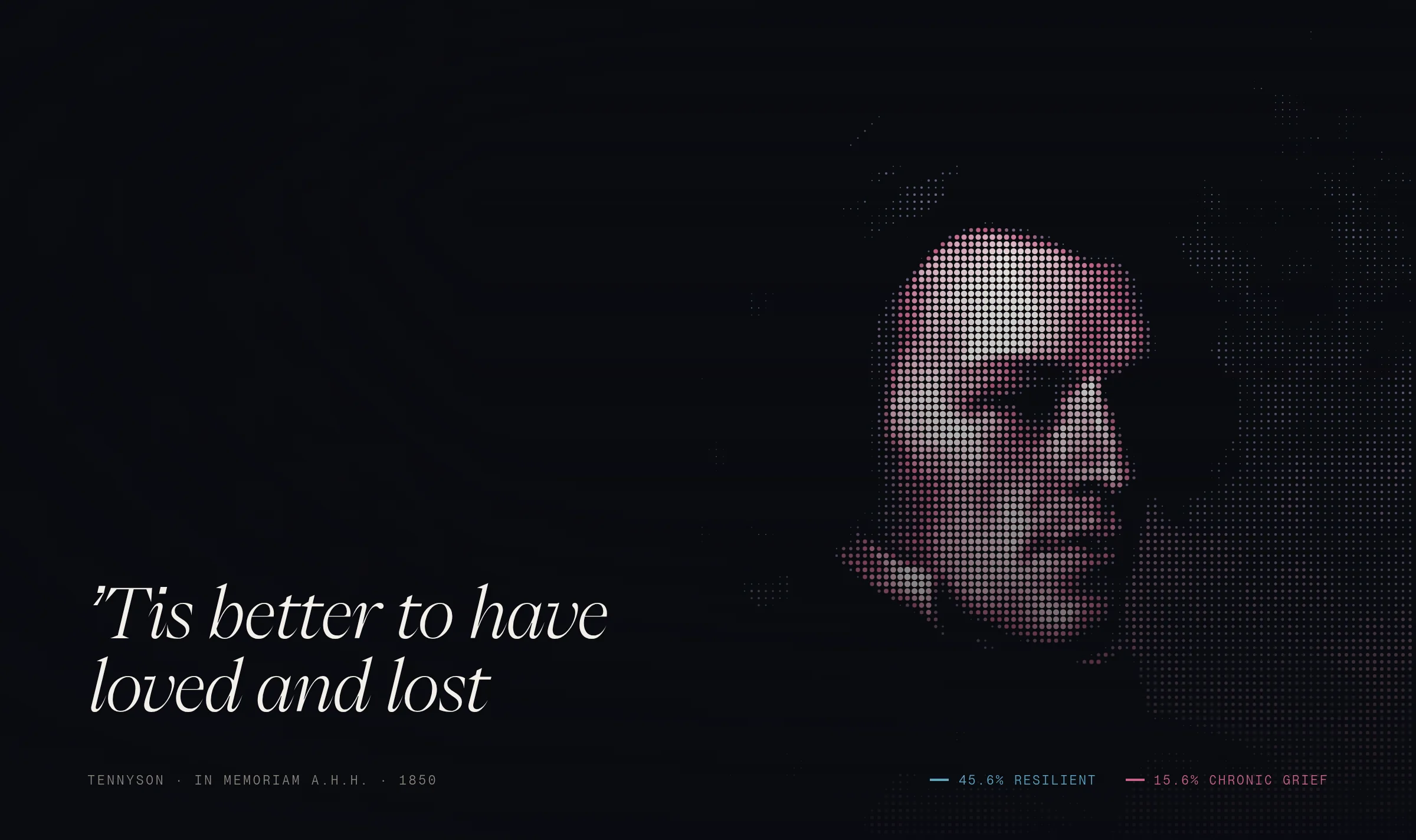
- Cover image: Alfred Tennyson, oil on canvas, c. 1840, by Samuel Laurence, screened as a halftone for this post
- Martha Nussbaum, The Fragility of Goodness (Cambridge University Press, 1986)
- Daniel Kahneman, Thinking, Fast and Slow (Farrar, Straus and Giroux, 2011) — on duration neglect and the remembering self