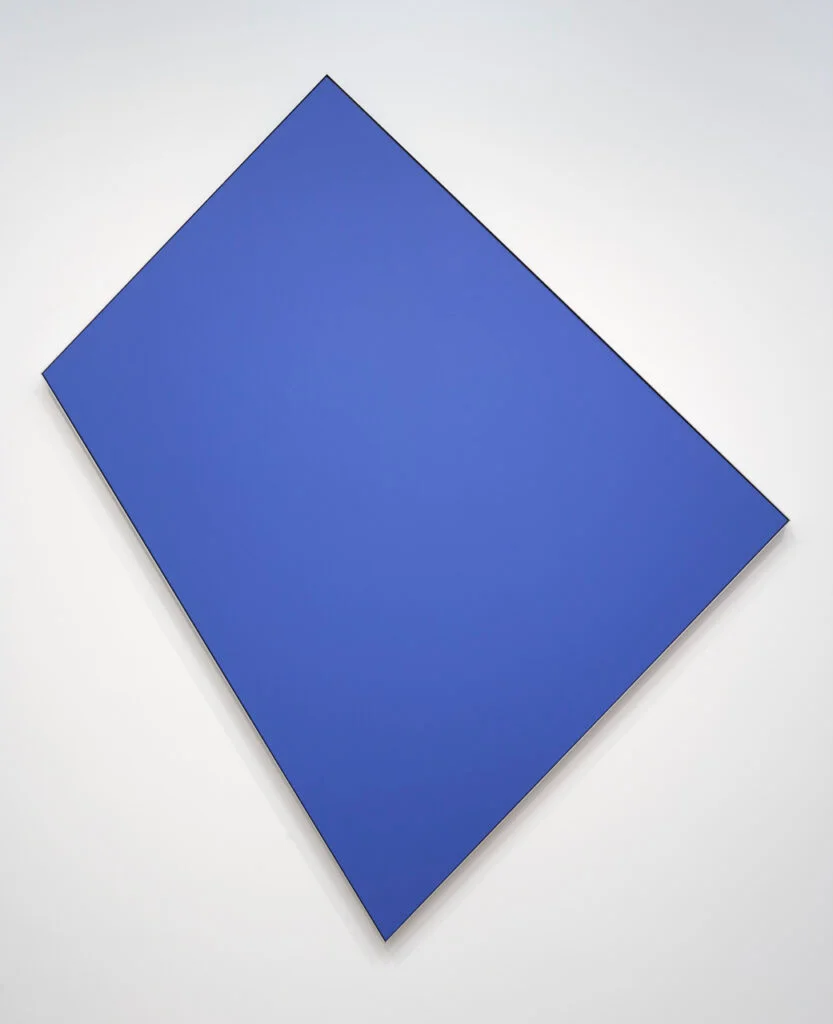
Ellsworth Kelly, Blue Panel, 1977. Collection of the North Carolina Museum of Art.
There's a feeling I wanted to make navigable, and it starts in an auditorium I wasn't supposed to be in.
It was my first semester of undergraduate school and I had signed up for Art from 1945 to Present, arriving with exciting new books and no idea the course was meant for seniors and graduate students. The professor made this clear on the first day. Then he went around the room, sixty or seventy students, each naming an art movement that hadn't been claimed yet. Being someone who preferred to stay out of sight, I sat in the upper rear of the auditorium. Panic was setting in almost immediately after the first three or four students at the front of the auditorium confidently selected their movements. Cubism, Impressionism, Pop Art, what's left? I opened the index of one of my new books (Artspeak) and was frantically marking movements as they were called out, heart racing, scanning for anything unclaimed.
"I'm Danny. Constructivism?"
He asked where that was mostly happening. I found it in the index before he finished the question.
"Russia?"
Russian Constructivism, to be exact. He said a few words about it and moved on, and I exhaled. After class I went up and told him I was a first year and really wanted to stay. He was reluctant at first, and then he agreed.
That course changed everything. While others were beginning at the beginning, with cave art and primitivism, I had jumped four thousand years and landed in the middle of Rauschenberg and Gober and Bourgeois and El Lissitzky and László Moholy-Nagy, surrounded by dense manifestos and theory and research and writing I had no preparation for and loved immediately. Art history wasn't slides to memorize but a world with edges I couldn't find and kept wanting to reach.
What I carried out of that year is the same feeling I kept returning to long after: that artists are always in relation to each other, across time and geography and demographics, connected by preoccupations they often couldn't name. My own circle of friends was doing it too, making work with common themes none of us had coordinated. The connections were real, they just weren't visible in the way art history was usually taught, flattened into sequence when the actual thing was simultaneous and overlapping and full of people calling across distances they couldn't see, sometimes to someone who wouldn't be born for two hundred years.
The project takes its name from Ellsworth Kelly as a kind of design brief, but that's only part of the reason. His work operates at reduction, dark ground, color carrying all the meaning, nothing in the frame that doesn't earn its place, and that became the standard I held the interface to: museum-level density, no visual noise, the data given enough space to be itself.
But Kelly has meant something else to me as well. His work is among the rare things in art that you can appreciate on the first encounter with no knowledge at all, a shape, a field of color, something in the relationship between them that lands before language does. And then, as life moves through you, the same works begin to carry new weight. His paintings have been present through solitude and introspection, through grief and trauma and recovery, through the moments when you need something that asks nothing of you but holds you anyway. I owe a great deal to Ellsworth Kelly in ways that have nothing to do with design.
Naming this project after him was an act of gratitude, and what I hope for it is that it might grow into something like what his work has grown into for me over the years: something you can enter on the first day with no preparation and find beautiful, and return to across a life and discover, each time, that it carries something new about who you are and the world you're moving through.
The interface runs on movement accent colors not chosen by eye but extracted from thousands of paintings through color clustering. What surprised me most in building it was finding that the shift in pigmentation when tube paint arrived in 1841 is legible in the data. You can watch Impressionism's palette open up, the colors loosening and brightening as if the paintings had been holding their breath. The colors in Ellsworth come from the chromatic record of thousands of works and carry something of the periods they describe, the way pigment carries time and place in its chemistry.
There's a feature called Threads that maps recurring themes across centuries, mortality, the sublime, the female form, as a graph where artists four hundred years apart are linked through the same preoccupation. It's the part I return to most often, not because it's technically surprising but because it confirms something I've believed since that first auditorium: that the obsessions travel, finding new carriers in every century and leaving traces in the work that carry forward into whoever encounters them next and takes them somewhere the original artist couldn't have imagined.
The influence network is the same intuition made visible differently, tracing who responded to whom through what lineage, going back as far as the records hold. You can chase Cy Twombly backward through his influences and keep going until the network thins and the documentation runs out and you're left with what was passed between people whose names we mostly don't have anymore.
I built this the way I build anything I care about, starting from the feeling I wanted to feel and working backward into what would have to exist to produce it. The proportional timeline, the force-directed graph, the color palettes are all instruments, and what they're in service of is a feeling that existed long before any of them did.
What I want is to sit with thousands of years of human creative life and see and feel the connections rather than just read about them. To look at the late 1800s and experience Impressionism, Post-Impressionism, and Symbolism crashing into each other as a living event, the way it must have felt to people actually inside it, before anyone had named any of it or written the chapter.
Ellsworth is where all of that lands. The auditorium, the teachers, thousands of years of humans making art and handing things forward to someone they couldn't see. I built it from a feeling, and the feeling came from somewhere.
The teachers and professors who helped shape me as an artist, from grade school through graduate school, listed alphabetically: Miroslav Antic, Marilyn Arsem, Bob Bersson, Fritz Buehner, Ondine Chavoya, Patsi Compton, Stuart Downs, Rebecca Humphrey, Bernie Leigg, Jack McCaslin, Rita McCaslin, Ken Szmagaj, Cynthia Thompson, Millicent Young, Sang Yoon, Chantal Zakari, Steve "Captain" Zapton, and so many others. What I learned in those years is still in motion.
Check out an overview of Ellsworth in Projects · Check out Ellsworth.ai